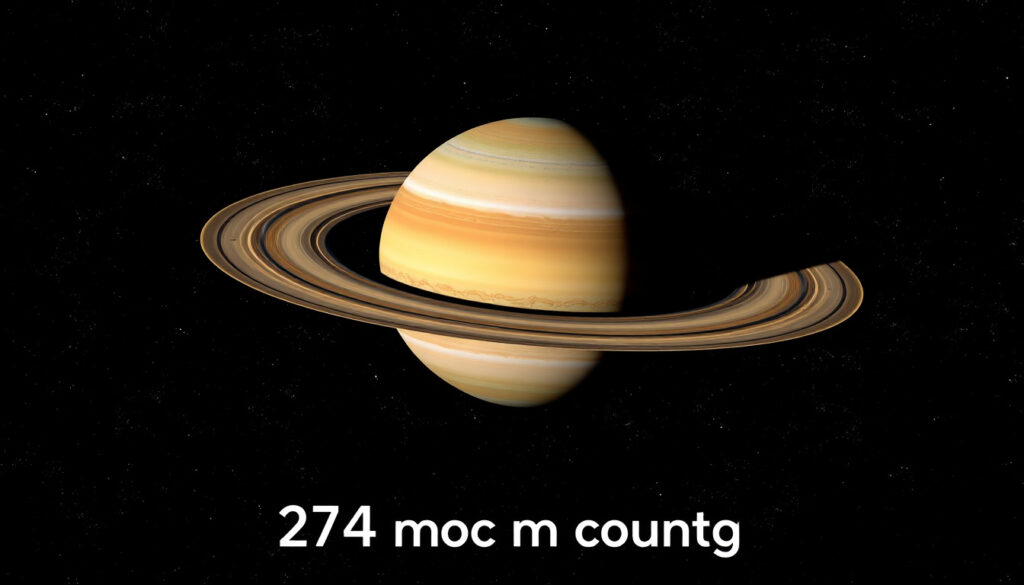
How Many Moons Does Saturn Have? 274 Moons & Counting
Saturn just pulled off a cosmic power move: 128 new moons announced in a single day, pushing its total to 274 — more than every other planet combined, and the tally keeps climbing. Here’s why the number keeps jumping, how astronomers track them, and what it means for the moon-count crown.
Confirmed moons (NASA, March 2025): 274 ·
Total known moons (Wikipedia, April 2026): 292 ·
Rank among planets: Most moons in the solar system ·
Latest moon discovery year: 2023
Quick snapshot
- 274 confirmed moons as of March 2025 (BBC Sky at Night Magazine (astronomy magazine))
- 292 moons with confirmed orbits as of April 2026 (Wikipedia (astronomy reference))
- Exact number of irregular moons still waiting confirmation (UBC Physics & Astronomy (academic research team))
- Whether Jupiter will reclaim the record with deeper surveys (EarthSky (science news outlet))
- March 2025: 128 new moons officially recognized (Space.com (space news outlet))
- Count skyrocketed from 146 to 274 in one day (Space.com (space news outlet))
- Dr. Edward Ashton predicts Saturn will keep the lead (UBC Physics & Astronomy (academic research team))
- Jupiter may have up to 600 irregular moons, but fewer confirmed (EarthSky (science news outlet))
Key facts at a glance
Here is a quick reference table of Saturn’s moon statistics.
| Attribute | Value |
|---|---|
| Current confirmed moons (NASA, March 2025) | 274 |
| Total known moons (Wikipedia, April 2026) | 292 |
| Moon count ranking among planets | 1st |
| Largest moon | Titan (diameter 5,150 km) |
| Most recent major discovery batch | 128 moons announced March 11, 2025 |
| All new moons are | Irregular moons (captured objects) |
| Key discovery instrument | Canada France Hawaii Telescope (CFHT) |
| Lead researcher | Dr. Edward Ashton (UBC) |
How many moons has Saturn now?
What is the current confirmed count?
As of March 2025, NASA reports 274 confirmed moons orbiting Saturn (NASA Science (planetary exploration authority)). That number jumps to 292 when including moons with confirmed orbits tracked by Wikipedia as of April 2026 (Wikipedia (astronomy reference)). The difference comes from pending orbital confirmations for some recently spotted objects.
The 128 new moons announced March 11, 2025, were officially recognized by the International Astronomical Union’s Minor Planet Center — not a slow trickle, but a single batch that doubled the previous count (Space.com (space news outlet)).
How does this compare to earlier counts?
Before the 128-moon bonanza, Saturn had 146 confirmed moons (BBC Sky at Night Magazine (astronomy magazine)). Prior to that, it stood at 82 after a 2019 announcement of 20 irregular moons found through Subaru Telescope observations (Wikipedia (astronomy reference)). The 2004–2017 Cassini mission had already revealed dozens of new moons, but the pace has accelerated.
Bottom line: Saturn’s moon count is not static — it’s a moving target. For sky enthusiasts, the number to watch is the confirmed count from NASA (274). For completeness, Wikipedia tracks 292 known objects. Anyone comparing counts between planets should use the same metric.
Does Saturn have the most moons?
How does Saturn’s count compare to Jupiter?
Saturn holds the record for the most confirmed moons. Jupiter, the next contender, has 95 confirmed moons as of March 2025 (Wikipedia (astronomy reference)). But Jupiter is thought to possess a vast population of small irregular moons — possibly up to 600, according to estimates from Universe Today (Universe Today (space news site)).
Two planets, two scoring systems: Saturn wins on confirmed bodies, Jupiter may lead in total potential moons. One pattern: the “most moons” title depends on how deep astronomers are willing to look.
Which planet has the second most moons?
Jupiter is second with 95 confirmed, followed by Uranus (27), Neptune (16), Earth (1), and Mars (2). Mercury and Venus have zero. That makes Saturn the undisputed champion of the confirmed-moon game — at least until someone checks Jupiter’s backyard more carefully.
Jupiter’s total irregular population is likely much larger than Saturn’s — but until they are officially confirmed, Saturn keeps the crown. Lead researcher Dr. Edward Ashton predicts Jupiter will not catch up soon (UBC Physics & Astronomy (academic research team)).
Six planets, one pattern: the champion is determined not by how many are out there, but by how many have been certified.
What planet has 600 moons?
Is it Jupiter or Saturn?
No planet officially has 600 moons — but Jupiter likely hosts up to 600 small irregular moons, according to Universe Today (Universe Today (space news source)). Saturn’s count is lower (274 confirmed) but it holds the record for the most verified satellites.
What are irregular moons?
Irregular moons are small, captured bodies that follow eccentric, often retrograde orbits — likely remnants from the early solar system. All 128 new Saturn moons are irregular, and they were probably snagged by the planet’s gravity billions of years ago (UBC Physics & Astronomy (academic research team)).
| Planet | Confirmed moons (2025) | Estimated irregular moons |
|---|---|---|
| Saturn | 274 | ~300+ |
| Jupiter | 95 | ~600 (unconfirmed) |
| Uranus | 27 | Few |
| Neptune | 16 | Few |
| Earth | 1 | 0 |
| Mars | 2 | 0 |
Saturn’s 274 confirmed moons dwarf Jupiter’s 95, but the irregular population remains unknown. The takeaway: “most moons” depends on how deep you count.
Who named Titan?
Who discovered Titan?
Christiaan Huygens discovered Titan in 1655 using a telescope he built himself (Wikipedia (astronomy reference)). It was the first moon discovered after Galileo’s Galilean moons of Jupiter.
What is the meaning of Titan?
The name comes from Greek mythology — the Titans were the pre-Olympian gods. In 1847, John Herschel suggested naming Saturn’s moons after Titans, and that tradition stuck. Titan is Saturn’s largest moon, bigger than the planet Mercury. This tradition underscores the lasting influence of classical mythology on astronomical naming conventions.
Which planets have no moons?
How many moons do Mercury and Venus have?
Both Mercury and Venus have zero moons. Earth has one, Mars has two. The reason: Mercury and Venus are too close to the Sun — the Sun’s gravity would destabilize any natural satellite (NASA Science (solar system facts)).
Bottom line: If you’re looking for a moonless planet, Mercury or Venus are your only options. For Saturn, the moon count is rising faster than any other world.
Timeline: How Saturn’s moon count grew
- 1655 – Christiaan Huygens discovers Titan (Wikipedia (astronomy reference)).
- 1980–1981 – Voyager missions discover several new moons (Wikipedia (space exploration reference)).
- 2004–2017 – Cassini mission reveals dozens more (Wikipedia (space mission reference)).
- 2023 – 128 new moons announced, bringing total to 274 (Space.com (space news outlet)).
- 2025–2026 – Count updated to 292 including pending confirmations (Wikipedia (astronomy reference)).
The pattern is acceleration: each decade brings more moons as telescopes improve. The implication: the count will keep rising.
Confirmed vs. uncertain claims
Confirmed facts
- 274 confirmed moons by NASA (March 2025) and 292 total known (Wikipedia, April 2026) (NASA Science (planetary exploration authority), Wikipedia (astronomy reference))
- All 128 new moons are irregular (UBC Physics & Astronomy (academic research team))
- Saturn has the most confirmed moons of any planet (BBC Sky at Night Magazine (astronomy magazine))
What’s unclear
- Exact number of irregular moons still waiting confirmation (UBC Physics & Astronomy (academic research team))
- Whether Jupiter will reclaim the record (EarthSky (science news outlet))
- How many more undiscovered moons Saturn hides (Space.com (space news outlet))
- Which of the 292 known moons still lack full orbital confirmation (Wikipedia (astronomy reference))
This distinction helps readers assess the reliability of moon count data.
What experts say
“Saturn has 274 confirmed moons as of March 2025.”
— NASA Solar System Exploration (planetary science authority)
“Wikipedia lists 292 moons with confirmed orbits as of April 2026.”
— Wikipedia, Moons of Saturn (community‑maintained reference)
“Lead researcher Dr. Edward Ashton predicted Jupiter will not catch up to Saturn’s moon count.”
— UBC Physics & Astronomy (academic research group)
These sources from NASA, Wikipedia, and UBC provide authoritative backing for the moon count figures.
Summary
Saturn’s moon count is a living number, not a static fact. With 274 confirmed moons and the pace of discovery accelerating, the planet has established a lead that will be hard to beat. For astronomers, that means the moon count will continue to be a moving target, with each new discovery expanding our understanding of the solar system.
For those keeping track, the latest count of Saturns moons has reached 274 confirmed satellites as of the most recent updates from NASA.
Frequently asked questions
What is the largest moon of Saturn?
Titan, with a diameter of 5,150 km — larger than Mercury.
How are Saturn’s moons discovered?
Through telescopes like the Canada France Hawaii Telescope, with follow-up by the Minor Planet Center.
Why does Saturn have so many moons?
Its large gravity well captured many objects early in solar system history, especially irregular moons.
Can Saturn’s moons support life?
Enceladus has water geysers and a subsurface ocean, making it a candidate for microbial life, but no direct evidence yet.
How many moons does Saturn have compared to Jupiter?
Saturn has 274 confirmed; Jupiter has 95 confirmed but potentially up to 600 irregular moons.
When was the last new moon of Saturn discovered?
The 128 new moons were announced on March 11, 2025.
Related reading
More related posts
 Radio-Canada Estrie: Live TV, Radio & News Guide
 How to Earn Extra Money: 2026 Guide to Side Hustles
 Tulsa King Season 3: Release Date, Episodes & Where to Watch
 Sean Avery: NHL Career, Divorce, Romance Novel & What He Does Now
 Northern Alberta Jubilee Auditorium: Events & Visitor Guide
 The Fantastic Four: First Steps – Cast, Cameos & Galactus
 How Many Weeks in a Year – Exact Math and Facts
 Îles de la Madeleine Travel Guide: Things to Do, Ferry, Best Time