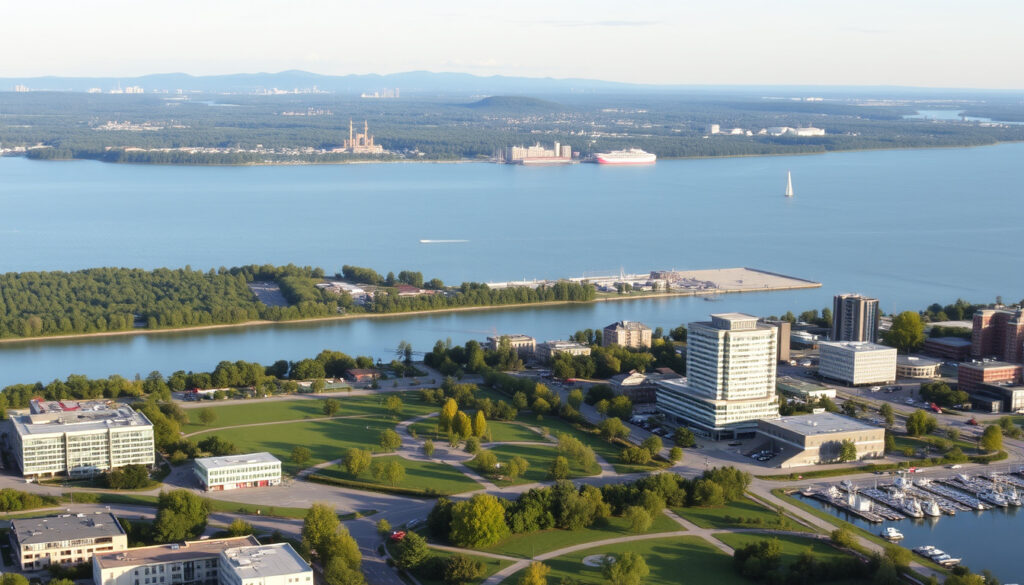
Regional Municipality of Halton: Services, Cities, Key Facts
Anyone who has tried to figure out which level of government handles a pothole or a recycling pickup in Halton Region already knows the answer isn’t always obvious — the Regional Municipality of Halton, covering Burlington, Oakville, Milton, and Halton Hills, operates under a two-tier system that splits responsibilities between the region and local municipalities, a model that often confuses newcomers and long-time residents alike. This guide lays out exactly what the region does, how to reach it, and where the boundaries between regional and local services fall.
Population: 650,000+ ·
Area: 1,006 km² ·
Established: 1974 ·
Municipalities: 4 ·
Government type: Regional municipality with two-tier system
Quick snapshot
- Four municipalities: Burlington, Oakville, Milton, Halton Hills (Halton Region)
- Regional government handles police, roads, waste, public health (Halton Region) (Halton Region)
- Administrative centre at 1151 Bronte Road, Oakville (Halton Community Resources)
- Exact population counts depend on census year — official data from Halton Region should be referenced
- Future municipal restructuring or amalgamation discussions are not confirmed
- Continued population growth projected, especially in Milton and Halton Hills (Halton Region) (Wikipedia)
- Ongoing planning for regional transportation and infrastructure (Wikipedia)
Seven key facts about the Regional Municipality of Halton, from its government structure to the services it manages directly.
| Fact | Value |
|---|---|
| Government type | Regional municipality (upper-tier) |
| Council | Regional Chair and 21 councillors |
| Population (2021 census) | 650,000+ |
| Area | 1,006 km² |
| Established | 1974 |
| Official website | www.halton.ca |
| Main phone | 3-1-1 (within region) or 905-825-6000 |
What is the Regional Municipality of Halton?
Definition and legal status
The Regional Municipality of Halton is an upper-tier municipal government in Ontario, Canada, created by the provincial government in 1974 (Wikipedia) as part of a broader regional reform. It serves four lower-tier municipalities: Burlington, Oakville, Milton, and Halton Hills. Unlike a single-tier city such as Toronto or Hamilton, Halton Region handles services that cross municipal boundaries—think major roads, water and wastewater, police, and waste management—while the local towns handle zoning, parks, and community services.
For anyone living in Halton, knowing which government to call can save hours. Report a pothole on a regional road? That’s the region. Report a missing stop sign on a local street? That’s your town. The split isn’t arbitrary—it’s designed so that big-ticket infrastructure is funded and managed region-wide.
Two-tier government model
- The Region collects property taxes on behalf of itself and the local municipalities, then redistributes funds. (Halton Region)
- Regional council consists of the Regional Chair (elected at large) and 21 councillors from the four local councils. (Wikipedia)
- Local municipalities retain control over community-level decisions such as building permits and local bylaws. (Halton Region)
When calling 311, specify whether your issue is regional or local to get routed faster.
Difference from single-tier municipalities
In single-tier cities like Hamilton, one municipal government provides all services. In Halton, services are split: the region handles water, wastewater, regional roads, police, waste processing, public health, and social services; local towns handle fire, local roads, parks, libraries, and bylaw enforcement. This dual structure means residents pay two portions of property tax—one to the region, one to their local municipality. (Wikipedia)
What cities are in Halton Region?
City of Burlington
Burlington is the largest city in Halton Region by population, with roughly 200,000 residents. It sits on the shore of Lake Ontario and is the region’s primary urban centre for lakefront living and commercial development. (Wikipedia)
Town of Oakville
Oakville, with a population around 220,000, is the region’s corporate hub, hosting headquarters for companies like Ford Motor Company of Canada. It also houses the Halton Regional Centre at 1151 Bronte Road, the administrative heart of the Region. (Halton Region)
Town of Milton
Milton, home to about 130,000 people, has been the fastest-growing municipality in Halton over the past two decades. It is located inland, north of Oakville. (Wikipedia)
Town of Halton Hills
Halton Hills, comprising Georgetown and Acton, has about 65,000 residents and is primarily rural and suburban, covering the northern part of the region. (Wikipedia)
The pattern: each community has a distinct character, but all share the same regional services, from police to public health.
How do I contact Halton Region?
Phone and 3-1-1 service
- Within Halton Region, dial 3-1-1 for all regional services. (Halton Region)
- Outside the region or on mobile, call 905-825-6000. (Halton Region)
- TTY service for the hearing impaired: 905-827-9833. (Halton Community Resources)
- Toll-free for some services: 1-866-442-5866. (Halton Community Resources)
Website and online forms
The official website halton.ca provides service information, online applications for housing, waste collection schedules, and more. Residents can report issues like potholes or missed pickups through the website. (Halton Region)
Walk-in centres: Halton Regional Centre
The main administrative offices are at the Halton Regional Centre, 1151 Bronte Road, Oakville, ON L6M 3L1. Office hours are Monday to Friday, 8:30 a.m. to 4:30 p.m. The building is fully accessible. (Halton Community Resources)
Mailing address
Regional Municipality of Halton
1151 Bronte Road
Oakville, ON L6M 3L1Halton Region (official government website)
Call 311 for regional services; use your town hall for local permits and bylaw issues. The region’s website and walk-in centre cover most cross-boundary needs.
What services does Halton Region provide?
Six major service areas that the region manages directly—and where you should turn for help.
Public works and roads
Halton Public Works maintains regional roads, water and wastewater systems, and winter road clearing. The Region operates five divisions to deliver these services. There are no eligibility restrictions or fees for general public works services. (Halton Community Resources)
Police and emergency services (Halton Regional Police)
The Halton Regional Police Service provides policing across all four municipalities. It is funded and managed at the regional level to ensure consistent coverage. (Halton Region)
Waste management and recycling
The region handles waste collection, recycling, and organics programs for all households. Collection schedules vary by municipality, but the region coordinates the overall system. (Halton Region)
Public health
Halton Region Public Health offers immunization clinics, food safety inspections, sexual health services, and communicable disease control. These programs are delivered region-wide. (Halton Region)
Social services and housing
Social services include Ontario Works (employment and financial assistance), children’s services, and subsidized housing through Halton Access to Community Housing (HATCH). Residents can apply online at halton.ca/housing or by calling 311. (Halton Rent Connect)
Planning and development
The region oversees official plans, growth management, and environmental assessments that affect multiple municipalities. Local municipalities handle individual building permits. (Halton Region)
Halton Region handles cross-boundary services like major roads and police; local towns handle zoning and building permits. Knowing the split saves time.
What is the population and area of Halton Region?
Population estimates and growth
According to the 2021 census, the population exceeds 650,000 residents. The region has grown rapidly, especially in Milton and Oakville, which saw double-digit percentage increases over the last two decades. (Wikipedia)
Geographic size
Halton Region covers approximately 1,006 km² (388 square miles), stretching from Lake Ontario in the south to the northern farmland and escarpment areas in Halton Hills. (Halton Region)
Density and urban/rural split
The southern part (Burlington and Oakville) is urban and suburban, while the northern two municipalities (Milton and Halton Hills) include significant rural and farmland areas. The region’s growth plan concentrates development in urban areas to preserve green space. (Wikipedia)
Halton’s population exceeds 650,000 and is growing fastest in Milton and Oakville. Always check the latest census data for official numbers.
Clarity: Confirmed facts vs. what’s unclear
Confirmed facts
- Halton Region comprises Burlington, Oakville, Milton, and Halton Hills. (Halton Region)
- Regional government provides police, roads, waste management, and public health. (Halton Region)
- Main administrative centre is at 1151 Bronte Road, Oakville. (Halton Community Resources)
What’s unclear
- Exact population numbers vary by year; official census data should be referenced. (Wikipedia)
- Future municipal restructuring or amalgamation discussions are not confirmed. (Halton Region)
- Established in 1974 — though widely cited, some sources give slightly different dates. (Wikipedia)
- Contact via 3-1-1 or 905-825-6000 — numbers may change with service updates. (Halton Region)
Quotes about the region
The Regional Municipality of Halton provides a wide range of services to residents and businesses across Burlington, Halton Hills, Milton, and Oakville.
Halton Region (official government website)
Halton Region was created in 1974 as part of a province-wide restructuring of local government in Ontario, replacing Halton County.
Wikipedia (user-contributed encyclopedia)
The region’s own framing emphasizes its role as “critical municipal infrastructure and services that support daily activities,” while historians highlight its origin in Ontario’s push toward regional efficiencies.
Summary: what this means for residents
Halton Region’s two-tier system is neither better nor worse than a single-tier government—it’s simply a division of labour designed for a growing, geographically diverse area. For residents, the key is knowing the boundary: call the region for regional roads, police, waste collection, public health, housing, and social services; call your local municipality for parks, libraries, local roads, and building permits. For anyone moving to Burlington, Oakville, Milton, or Halton Hills, the single most important number to memorize is 3-1-1—it’s your direct line to the regional services that affect your daily life.
Related reading: Things to Do This Weekend – Toronto and Durham Events · Fairview Park Mall Directory: Full Store List, Map & More
21554643.fs1.hubspotusercontent-na1.net, oakville.ca, haltonrentconnect.ca, haltonhills.ca
Frequently asked questions
What is the Halton Region phone number?
Call 3-1-1 within the region, or 905-825-6000 from outside or on mobile. (Halton Region)
Is Halton Region part of the Greater Toronto Area?
Yes, Halton Region is part of the Greater Toronto Area (GTA), the most populous metropolitan region in Canada. (Wikipedia)
How do I apply for building permits in Halton Region?
Building permits are handled by your local municipality, not the region. Contact Burlington, Oakville, Milton, or Halton Hills directly. (Halton Region)
What is the weather in Halton Region?
Halton Region has a humid continental climate with warm summers and cold winters. Check regional weather alerts from Environment Canada, as the region monitors weather-related road conditions.
Are there recycling programs in Halton Region?
Yes, the region runs curbside recycling and organics collection for all households. Schedules and acceptable materials are posted on halton.ca. (Halton Region)
How do I report a pothole on a regional road?
Call 3-1-1 or use the online form at halton.ca. Potholes on local streets should be reported to your town. (Halton Region)
What is the Regional Municipality of Halton address?
The main administrative address is 1151 Bronte Road, Oakville, ON L6M 3L1. (Halton Community Resources)
More related posts
 $40 USD to CAD: Live Rates from Wise, Revolut, Xe
 Elaine Hendrix: Biography, Career and Parent Trap Legacy
 Où Voter Aux Élections Fédérales – Guide Complet Elections Canada
 300 Million Won to CAD – Live Rates and Conversion Guide
 Super Bowl 2026 Halftime Show: Performers, Time & More
 Myers-Briggs Personality Test: Free Options & Valid
 Rose Byrne: Biography, Children, Net Worth, and Brad Pitt Connection
 Sticky Toffee Pudding Recipe: Gordon Ramsay vs Nigella vs Berry