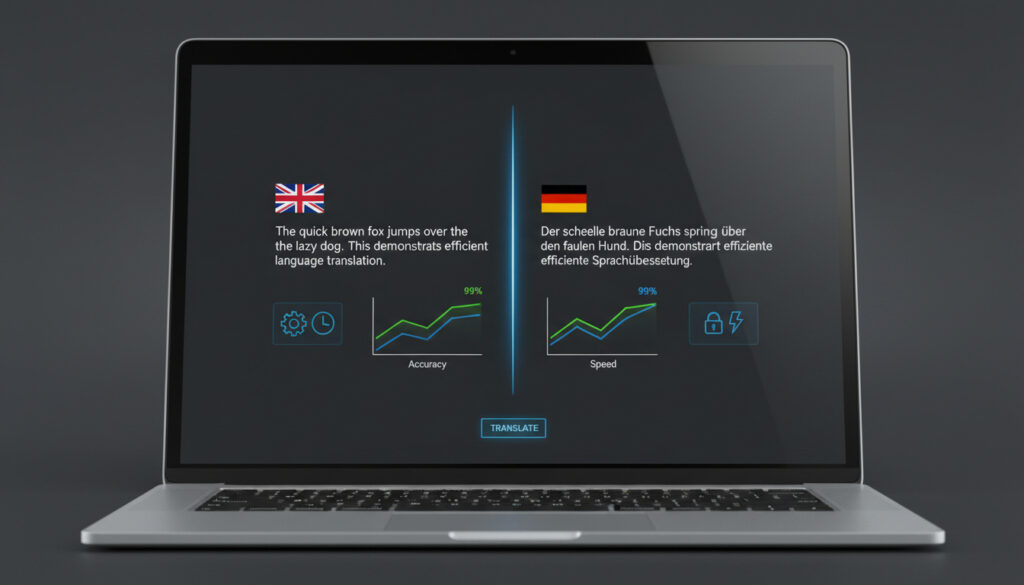
Translate English to German – Best Tools and Accuracy Guide
Bridging language barriers between English and German requires more than simple word substitution. Modern translation technologies leverage neural networks to handle complex grammatical cases, gendered nouns, and specialized terminology across web platforms, mobile applications, and real-time communication systems.
The current landscape ranges from browser-based solutions suitable for casual conversation to enterprise-grade systems managing legal contracts and technical documentation. Selecting appropriate tools depends on accuracy requirements, format compatibility, and whether the translation involves real-time speech, static documents, or mobile messaging.
This analysis examines current capabilities, limitations, and practical workflows for converting English content into German, drawing from verified tool specifications and linguistic research.
What is the Best English to German Translator?
Several platforms dominate the English-to-German translation space, each optimizing for different use cases. DeepL consistently ranks highest for accuracy in European language pairs, while real-time specialists like JotMe focus on zero-latency video conferencing integration. For a detailed comparison of top solutions, see Best English to German Translators.
DeepL (highest accuracy for European languages)
Yes, unlimited basic use with ad support
95%+ for standard professional text
iOS and Android applications available
- DeepL demonstrates superior natural phrasing compared to statistical models
- Machine systems struggle with cultural idioms and regional dialects
- Free tiers suffice for informal communication; paid tiers necessary for professional documents
- Real-time translation tools offer zero-latency solutions for video conferencing platforms
- Grammar differences between English and German significantly impact translation fidelity
- Mobile apps now support offline functionality for basic vocabulary
- Enterprise systems integrate directly with document management platforms
| Feature | DeepL | Google Translate | JotMe |
|---|---|---|---|
| Languages Supported | 42 | 100+ | 77 (Chrome), 45 (Desktop) |
| Free Tier Limits | 500k characters/month | Unlimited | Basic real-time features |
| Best For | Nuanced text | Quick lookups | Video calls |
| Document Upload | PDF, Word supported | Multiple formats | Limited |
| API Availability | Yes | Yes | Yes |
| Offline Mode | No | Yes (mobile app) | No |
| Pricing (Paid) | €2.99/month | Free/Paid API | $15/month |
| Platform Integration | Web/API | Web/Mobile | Meet/Teams/Zoom |
How Do I Translate English to German Online?
Web-based translation follows distinct workflows depending on content format and urgency. Browser extensions provide immediate word and phrase conversion, while dedicated platforms handle complex document preservation.
Browser-Based Solutions
Modern browser extensions integrate directly with email clients and web forms, offering instant hover-translation for unfamiliar terms. These tools typically connect to cloud-based neural engines, requiring stable internet connections but providing access to continuously updated language models.
Document Translation Workflows
For formal documents, specialized platforms maintain original formatting while converting content. Pairaphrase supports over 25 file types including PDF and Word documents, preserving layout elements during translation. This approach proves essential for business contracts and technical manuals where formatting carries legal or operational significance.
Upload files directly to specialized platforms rather than copying text manually to preserve formatting, metadata, and structural elements essential for professional documents.
Mobile Application Methods
Smartphone applications increasingly offer camera-based translation for signs and menus, alongside voice conversation modes for travel scenarios. These apps typically require internet connectivity, though some provide downloadable language packs for offline use in areas with limited connectivity.
How Accurate is Machine Translation from English to German?
Neural machine translation has fundamentally altered accuracy expectations for English-to-German conversion. DeepL and similar platforms utilize deep learning models trained on multilingual corpora to predict contextually appropriate German phrasing rather than relying on word-by-word substitution.
Neural Network Capabilities
Contemporary systems achieve high fidelity with standard professional vocabulary and literal text. These platforms excel at maintaining consistent terminology across extended passages, handling complex sentence structures that earlier rule-based systems mangled.
Neural systems achieve 95% or higher accuracy rates for literal text and standard business vocabulary, significantly outperforming previous computational approaches.
Idiomatic and Contextual Limitations
Machine systems consistently fail with English idioms and culturally specific expressions. Phrases like “break a leg” or “kick the bucket” produce literal German translations that native speakers find nonsensical or confusing.
Cultural nuances, humor, and sarcasm frequently disappear during automated conversion, potentially causing misunderstandings in sensitive communications.
Professional vs Machine English to German Translation?
The choice between automated tools and human translators depends on content sensitivity and domain complexity. Gengo provides access to thousands of certified German translators for high-stakes documents, while specialized services handle transcription and subtitling requirements.
Machine translation suffices for internal communications, travel, and initial understanding of foreign content. However, legal contracts, medical documentation, and marketing materials require human oversight to navigate German grammatical cases and cultural conventions. DeepL’s premium tiers offer custom vocabulary support for technical domains, but human reviewers remain essential for final verification.
Evolution of English to German Translation Technology
- — Google Translate launches statistical machine translation precursor
- — Neural machine translation revolution begins, dramatically improving contextual understanding
- — DeepL founded, focusing specifically on neural accuracy for European language pairs
- — Document translation capabilities added to major neural platforms
- — Mobile applications mature with expanded API integrations and real-time features
- — Expected multimodal advances incorporating voice and image recognition technologies
Established Facts vs Persistent Uncertainties
| Verified Capabilities | Known Limitations |
|---|---|
| 95%+ accuracy for literal text and standard vocabulary | Idioms and slang frequently lose cultural context |
| Free tools reliably handle everyday conversational phrases | Specialized domains (legal/medical) require human verification |
| Leading platforms update language models frequently | Dialectical variations (High vs Low German) challenge consistency |
| Neural networks outperform previous rule-based systems | Long-term contextual coherence in extended documents remains variable |
Understanding English to German Translation Challenges
German grammar presents distinct obstacles for automated systems. The language employs four grammatical cases (nominative, accusative, dative, genitive) and three grammatical genders (masculine, feminine, neuter), requiring translation algorithms to analyze sentence structure deeply to assign correct articles and endings. English reliance on word order for meaning contrasts sharply with German’s flexible syntax, where case markings indicate grammatical function.
The evolution from rule-based systems to neural networks marks a significant shift in capability. Early machine translation relied on bilingual dictionaries and grammatical rules, producing rigid, unnatural output. Modern neural systems analyze vast multilingual corpora to predict likely translations based on context rather than literal substitution, resulting in more fluid German prose.
User scenarios vary dramatically in requirements. Casual travelers need quick phrase conversion for navigation and dining, while business users require precise terminology for contracts. Traditional platforms serve static document processing, whereas real-time tools facilitate international video conferencing.
Expert Perspectives on Translation Technology
Neural networks mimic human fluency better than any previous computational approach to language conversion.
— DeepL Research Overview
Machine translation quality improved sixty-fold since the neural revolution began in 2016.
— Google AI Technical Analysis
Key Takeaways for English to German Translation
Selecting appropriate translation tools requires matching specific needs to platform strengths. DeepL excels in nuanced text, Google Translate provides broad accessibility, and specialized services handle complex professional documents. For comprehensive research on language conversion technologies, see the English to German Translation: Comprehensive Overview.
Frequently Asked Questions
Is DeepL better than Google Translate for English to German?
DeepL generally produces more natural phrasing and better handles context for European languages, while Google Translate supports more languages and offers superior mobile offline capabilities.
What are the best free English to German translators?
DeepL offers a free tier with 500,000 characters monthly, Google Translate provides unlimited free use, and both support browser extensions without charge.
How do I translate a document from English to German?
Upload PDF or Word files to specialized platforms that preserve formatting, or use copy-paste methods for short texts in browser-based tools.
Are there free apps for English to German translation?
Both Google Translate and DeepL offer free mobile applications for iOS and Android, with optional offline language packs available for download.
How accurate is Google Translate for English to German?
Google Translate provides sufficient accuracy for travel and casual communication, though it occasionally misses nuanced phrasing that DeepL captures more reliably.
Translate English idioms to German accurately?
Machine translation typically fails with idioms, producing literal translations. Human translators or specialized idiom databases provide culturally appropriate equivalents.
Best websites for instant English to German translation?
DeepL and Google Translate offer the fastest browser-based conversion, while Linguee provides contextual examples from bilingual corpora for verification.
More related posts
 Jujutsu Kaisen Season 2: Netflix Release, Episodes & Streaming
 Lightning de Tampa Bay: History, Scores, Roster & Stanley Cups
 Rock Lee: The Ninja Who Proved Hard Work Beats Talent
 Bad Bunny Super Bowl – 2026 Headliner History Explained
 Tupac Shakur Death: Facts, Final Words & Estate
 Parker Posey: From Indie Queen to Superman & Prestige TV
 Jana Kramer: Marriages, Divorces, and Career
 Morgan Kohan: Age, Nationality, Relationship Status & Known For