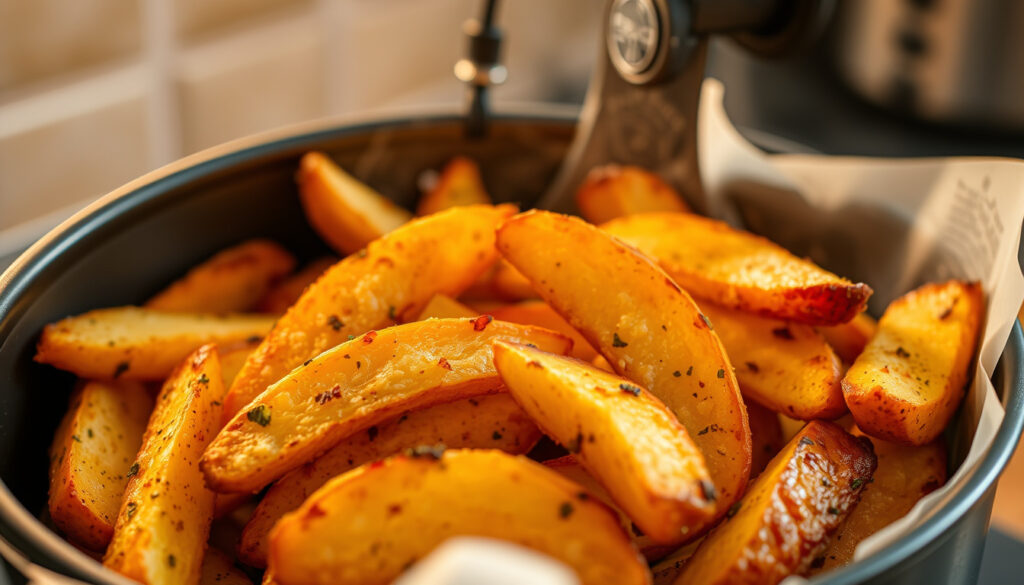
Air Fryer Potato Wedges: Crispy Recipe & Timing Guide
Pull a batch of air fryer potato wedges from the basket only to find them soft, pale, and disappointing—the difference between that outcome and restaurant-crispy edges comes down to specific moves most recipes skip.
Average Cook Time: 25-35 minutes · Typical Temperature: 180-200°C / 350-400°F · Prep Time: 10 minutes · Servings: 4 · Calories per Serving: 200-300
Quick snapshot
- Most recipes call for 400°F / 200°C cooking temperature (Sweet Peas and Saffron recipe)
- Shake or flip wedges every 5-10 minutes for even crispiness (Mary’s Whole Life quick method)
- Cook times range from 20-40 minutes depending on thickness (Kinder’s tested recipe)
- Optimal potato variety varies by desired texture (russet vs Yukon gold)
- Exact oil quantities depend heavily on basket size and wedge count
- Precise calorie counts without a complete ingredient spec remain estimates
- Soak phase: 10-30 minutes (removes starch for crispier edges) (Savory Nothings soak guide)
- Preheat: 5 minutes at cooking temperature (Sweet Peas and Saffron preheat tip)
- Cooking: 20-40 minutes total, with midway flip/shake (Savory Nothings soak guide)
- Salt immediately after cooking for maximum crunch (Eating by Elaine finishing technique)
- Store leftovers up to 48 hours in the fridge (Eating by Elaine finishing technique)
- Reheat at 400°F for 5 minutes to restore crispness (Eating by Elaine finishing technique)
These parameters represent the range of techniques confirmed across multiple recipe developers and video demonstrations.
| Parameter | Value | Source |
|---|---|---|
| Top Temp Range | 180-200°C | Multiple recipes |
| Soak Time | 30 minutes | Savory Nothings |
| Two-Stage Method | 350°F 15 min → 400°F 15 min | WellPlated.com |
| High-Temp Method | 425°F for 25-30 mins | Kinder’s |
| Preheat Duration | 5 minutes | Sweet Peas and Saffron |
| Flip Interval | Every 5-10 minutes | Mary’s Whole Life |
| Storage Life | 48 hours | Sweet Peas and Saffron |
| Total Time (with prep) | 38 minutes | Kinder’s |
How do you cook potato wedges in the air fryer?
Getting potato wedges right in an air fryer comes down to three moves: cutting them evenly, not skipping the preheat, and keeping them in a single layer. Every tested recipe that produces crispy results shares these habits (Sweet Peas and Saffron recipe method).
Ingredients needed
- 4 medium potatoes (russet or Yukon gold)
- 1-2 tablespoons olive oil or avocado oil
- 1 teaspoon salt
- ½ teaspoon garlic powder
- ½ teaspoon paprika
- ¼ teaspoon black pepper
Step-by-step cooking process
- Cut: Slice each potato into 8-10 uniform wedges for even cooking (Savory Nothings cutting guide). Aim for pieces roughly the same size so nothing burns while other wedges stay raw.
- Soak: Submerge the wedges in cold water for at least 10 minutes, ideally 30. This leaches surface starch that would otherwise steam the wedges instead of crisping them (Savory Nothings soak technique).
- Dry: Drain and pat each wedge completely dry with a clean towel. Any remaining moisture fights the crisping process.
- Season: Toss with oil first, then add spices. An even oil coat means seasoning sticks uniformly (Savory Nothings seasoning method).
- Preheat: Run the air fryer at your target temperature for 5 minutes before adding the wedges (Sweet Peas and Saffron preheat instructions).
- Arrange: Place wedges cut-side down in a single layer. Overcrowding steams; a single layer crisps (YouTube air fryer demo).
- Cook: Set your temperature and timer—see the timing section below for what works best.
- Flip: Shake the basket or use tongs to flip wedges halfway through. Uneven flipping produces patchy results (Eating by Elaine flipping technique).
Placing wedges cut-side down initially gives the flat cut face direct contact with the hottest airflow. This develops the sear that gives wedges their golden color.
Seasoning options
Most home cooks stick with garlic powder, paprika, salt, and black pepper—the combination that works on everything from weeknight chicken to game-day spreads (Savory Nothings seasoning guide). For something bolder, Kinder’s recommends steakhouse seasoning; for heat seekers, WellPlated.com adds chili powder as a variation. Parmesan and fresh parsley tossed on immediately after cooking adds a finishing touch some cooks swear by (Savory Nothings finishing touches).
Try these salsa recipes and tips for dipping wedges.
How long do you cook raw potato wedges in the air fryer?
Raw potato wedges in an air fryer typically need 20 to 40 minutes total, with the exact time hinging on potato size, thickness, and your preferred crispiness level. Testing a few batches reveals the sweet spot, and most recipes land somewhere in the middle.
Time for raw vs parboiled
Raw wedges from scratch take 25-35 minutes at 400°F, depending on thickness (Sweet Peas and Saffron timing guide). Parboiling wedges for just 5-7 minutes before air frying cuts the total appliance time down but adds back kitchen prep. For a weeknight shortcut, Savory Nothings notes the parboil route shaves about 10 minutes off the air fryer stage but requires drying the wedges thoroughly afterward.
Factors affecting cook time
- Potato type: Russets are starchy and cook faster; Yukon gold has more moisture and may need extra time (With the Woodruffs potato comparison).
- Wedge thickness: Thinner wedges finish in 20 minutes; thicker cuts need 30+.
- Single vs two-stage cooking: A two-stage approach (start lower, finish higher) adds a few minutes but yields a crispier exterior.
- Basket load: A full basket forces longer times; cook in batches if your air fryer is small (Savory Nothings batch cooking tip).
Doneness checks
The most reliable doneness test is breaking one wedge open: the skin should be deep golden and crispy, while the interior yields easily with a fork but isn’t falling apart (Sweet Peas and Saffron doneness test). If the outside looks done but the center still feels raw, return the wedge to the basket for another 3-5 minutes.
A 5-quart air fryer holds roughly half a batch for four servings. Trying to squeeze in extra wedges to save time produces uneven results—the wedges on the edges crisp while those in the center steam.
Do I need to boil potato wedges before air frying?
Boiling before air frying is optional, not required—and whether to do it depends on what you prioritize: convenience or maximum crispiness. Most experienced cooks skip the boil and let the air fryer do the work from raw.
Pros and cons of boiling
Boiling (or parboiling) for 5-7 minutes softens the interior so the air fryer only needs to crisp the outside. This shortens total cooking time and reduces the risk of burning the exterior before a raw center finishes. The tradeoff is added prep steps and the critical need to dry wedges completely—wet surfaces steam, not crisp (WellPlated.com parboil method).
Alternatives like soaking
A 30-minute cold water soak accomplishes a similar starch-removal goal without kitchen heat. Soaking pulls excess starch from the surface, which lets the wedge dry faster and crisp more aggressively in the hot air (Savory Nothings soaking technique). Even a 10-minute soak makes a noticeable difference compared to no soak at all.
No-boil methods
The straightforward no-boil method works well when you have time for a longer air fryer run. Cut, soak, dry, season, and cook at 400°F for 20-30 minutes with one or two shakes. The exterior crisps fully while the interior finishes naturally. With the Woodruffs notes that skipping the boil does require patience but rewards you with more potato flavor concentration.
Do you put oil on wedges in an air fryer?
Yes—a light oil coat is essential for crispiness in an air fryer, but more is not better. The air fryer’s hot circulating air needs just enough oil to brown the surface without creating a greasy barrier that steams instead of crisps.
How much oil
Most recipes call for 1-2 teaspoons of oil per pound of potatoes (Savory Nothings oil measurements). The goal is a thin, even coating—think misted, not drenched. A spray bottle distributes oil more uniformly than tossing with a spoon, which can concentrate oil on some wedges and leave others dry.
Best oils to use
Olive oil and avocado oil are the top choices for air fryer wedges. Both have smoke points high enough to handle 400°F cooking without breaking down into off-flavors (Savory Nothings oil guide). Avocado oil in particular has a neutral flavor that lets seasoning shine, while olive oil adds a subtle fruitiness some cooks prefer.
Oil-free options
For a lower-calorie version, you can skip the oil entirely—though the exterior won’t achieve quite the same crunch. Herb-seasoned oil-free wedges work as a lighter side dish, and the trade-off in crispiness is acceptable if you’re watching fat intake (With the Woodruffs light version). The texture difference is noticeable: oil-free wedges brown less evenly and lack the shatter-crisp exterior.
Salt naturally draws out moisture during cooking, so salting immediately after cooking ensures maximum crispiness. — Eating by Elaine
Post-cooking salt matters as much as pre-cooking oil. Eating by Elaine notes that seasoning the wedges right out of the basket—while they’re still steaming hot—draws out a final bit of surface moisture and locks in the crisp texture before it cools.
What are common mistakes when air frying wedges?
Most air fryer failures trace back to three habits: overcrowding the basket, skipping the midway shake, and starting with wet potatoes. Fixing these three issues handles the majority of disappointing results.
Overcrowding basket
Cramming wedges together into a full basket is the most common mistake. The wedges on the bottom and sides end up steaming in their own moisture while the ones near the heating element burn. A single layer with slight spacing allows hot air to circulate freely around each piece (Savory Nothings overcrowding warning). If your air fryer is smaller than 5 quarts, plan on two batches for four servings.
Skipping preheat
Dropping wedges into a cold air fryer means the first few minutes of cooking happen at below-target temperatures, extending total time and producing uneven results. A 5-minute preheat gets the cooking chamber and the basket to temperature so the first wedge cooked behaves the same as the last (Sweet Peas and Saffron preheat importance).
Uneven cutting
Wedges cut at different thicknesses cook at different rates—thin pieces burn before thick ones finish. Taking the time to cut each wedge to roughly the same size, targeting 8-10 wedges per medium potato, pays off in uniform results (Savory Nothings cutting uniformity). Eating by Elaine recommends cutting into 16 wedges per potato for maximum uniformity.
Too much oil
Excess oil drips into the bottom of the air fryer basket, creates smoke, and leaves wedges heavy and greasy rather than crisp. Using a spray bottle to apply a fine mist rather than pouring oil directly keeps the coating light. If you hear sizzling sounds that intensify rather than fade, you’re likely using too much oil.
Check local fast food deals near me if you need a backup side.
Confirmed facts
- Cook times range 20-40 minutes across sources
- Shake basket every 5-10 minutes for even results
- 400°F is the most common temperature
- 5-minute preheat is standard practice
- Single layer essential for crispiness
- Storage life up to 48 hours in fridge
What’s unclear
- Exact oil quantities depend on basket size
- Precise nutritional values vary by recipe
- Optimal potato variety for specific results
My secret to getting potato wedges as crispy as possible is to first air fry them at 350 degrees for 15 minutes in order to fully cook the inside without the outside burning. — WellPlated.com
Soaking the cut wedges under cold water for 30 minutes results in crispier potato wedges. — Kinder’s
While mastering no-boil techniques for wedges, try the Toronto Editions 20-minute recipe that delivers golden, restaurant-quality crispiness in just 20 minutes.
Frequently asked questions
What temperature for air fryer potato wedges?
Most recipes use 400°F (200°C) as the target temperature. Some cooks prefer a two-stage approach—starting at 350°F for 15 minutes, then raising to 400°F for the final 15 minutes—to ensure the interior cooks fully without burning the outside (WellPlated.com temperature guide).
Are air fryer potato wedges healthy?
Air fryer potato wedges are lower in fat than traditional fried potatoes since they use far less oil—just 1-2 teaspoons per pound versus tablespoons in deep frying. A typical serving runs 200-300 calories with about 6-8 grams of fat when prepared with light oil.
Can I use cornstarch for crispier wedges?
Yes. Tossing wedges with a light dusting of cornstarch before cooking helps achieve crunchier edges and a more golden exterior. The starch coating browns faster than potato surface alone, giving wedges that restaurant-crispy texture (Kinder’s cornstarch technique).
How to make Parmesan air fryer potato wedges?
Toss cooked wedges immediately with grated Parmesan and fresh parsley while they’re still hot. The cheese melts slightly and adheres to the crispy surface, creating a flavorful coating. Savory Nothings notes that Parmesan and herb finishing is optional but elevates the wedges for serving alongside heartier mains.
Ninja air fryer potato wedges settings?
Ninja air fryers work well with the standard settings from other brands. Set the air fryer to 400°F, cook for 20-25 minutes, and shake the basket every 5-10 minutes. The Ninja’s even airflow distribution means wedges tend to crisp more uniformly than in some other models.
What dipping sauces pair with wedges?
Classic pairings include ranch dressing, chipotle mayo, garlic aioli, or marinara sauce. The wedges’ neutral potato flavor accommodates bold dips well, and seasoning variations (smoked paprika, chili powder) can be matched to your sauce choice.
Can I air fry frozen potato wedges?
Yes, frozen wedges come pre-cut and par-fried, so they need only 12-15 minutes at 400°F without any soak or prep. Check the package for manufacturer-specific instructions, as thickness varies by brand. Expect slightly less crispiness than fresh-cut wedges.
For home cooks chasing that perfect wedge—golden outside, fluffy inside, without a pot of oil on the stove—the path is straightforward: a quick preheat, a light oil mist, and a midway basket shake. The variables that matter are wedge thickness consistency and spacing in the basket. Get those right, and the air fryer delivers on its promise of hands-off crispy potatoes. Get them wrong—crowding the basket, skipping the shake—and you’ll spend 30 minutes steaming what should have been a shatter-crisp side. The good news: these are simple habits to build once you know why they matter.
More related posts
 How to Calculate Average: Formula, Steps & Examples
 Sinners (2025 Film) Showtimes – Find Theaters Tickets Near You
 Maxton Hall Season 2: Release Date, Episodes, Ending Explained
 Lee Min-Ho: Biography, Relationships, and Career Facts
 Jack Hughes Teeth, Dating, LGBTQ Support & Career Facts
 Reggie Miller: Career, Family, and the Unwon Ring
 What to Do to Be Productive: 12 Tips & Frameworks
 Toi et Moi Ring: Meaning, Celebrity Examples, and Price Guide