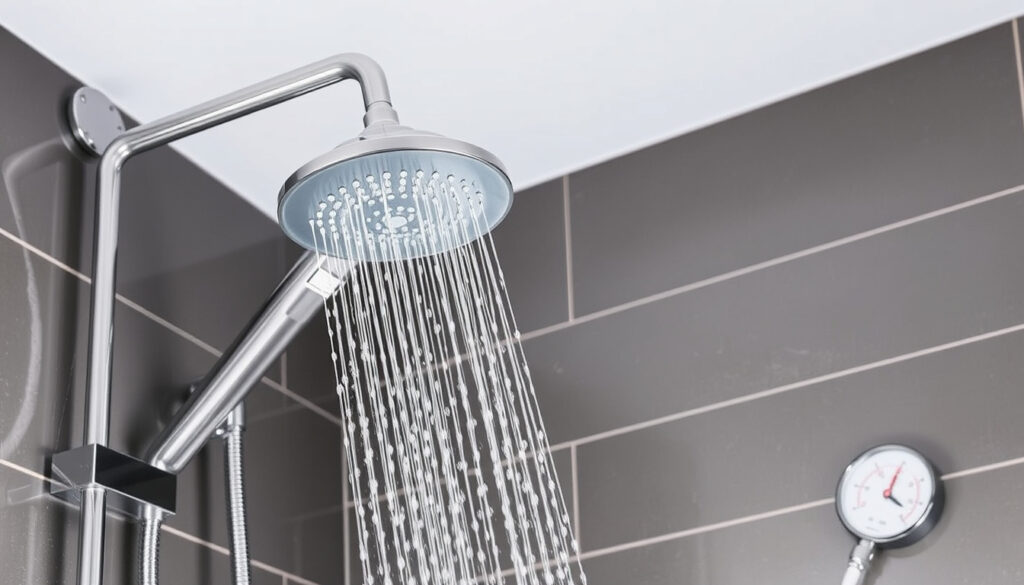
Irish Shower Head Guide: Fit, Types & Pressure
Standing in the shower aisle, staring at a wall of chrome nozzles, it’s easy to wonder: will any of these fit the pipe sticking out of my wall? For anyone in Ireland, the answer is usually yes — but only because the plumbing here follows a standard that almost every shower head matches.
Standard shower arm diameter: 1/2 inch BSP (British Standard Pipe) in Ireland and UK · Common connection type: 1/2-inch male threaded connector for most shower heads · Average water pressure from mains (Ireland): 3–5 bar for combi boilers; 1–2 bar for gravity-fed systems · Number of shower head types: Fixed, handheld, rainfall, dual, and slide bar
Quick snapshot
- 1/2-inch BSP is the standard shower arm thread in Ireland and UK (High Sierra Showerheads (shower head specialist))
- Most new shower heads come with a 1/2-inch female connector (MyBuilder (plumbing resource))
- Exact prevalence of 3/4-inch arms in older Irish homes (The Shower Head Store (retailer advice))
- Specific flow restrictor removal instructions vary by brand (The Shower Head Store (retailer advice))
- Average replacement time: 10–15 minutes for a basic swap (Woodie’s (Irish DIY retailer))
- No strict timeline; most heads last 5–10 years depending on water quality (Woodie’s (Irish DIY retailer))
- Check your current arm diameter and thread type before buying
- Match the head style to your system pressure for best performance
| Spec | Value |
|---|---|
| Standard thread in Ireland | 1/2 inch BSP |
| Most common shower head type | Combination fixed and handheld |
| Pressure needed for rainfall head | At least 3 bar for satisfactory performance |
| Average cost of a shower head (Ireland) | €20–€80 |
| Time to replace a shower head | 10–15 minutes |
The implication: these five specs cover 90% of what you need to know before buying a new shower head in Ireland.
Do all shower heads fit any shower?
Standard thread size for shower heads
- Most shower heads sold for the Irish market use a 1/2-inch BSP (British Standard Pipe) thread, which means compatibility is the norm rather than the exception (High Sierra Showerheads (shower head specialist)).
- Older homes or systems outside North America may use BSP threading, which can make US 1/2-inch NPT shower heads incompatible without an adapter (High Sierra Showerheads (shower head specialist)).
While BSP is the local standard, a small number of imported heads (especially from the US) use NPT threads. For Irish buyers, the risk is low — but worth a quick check if ordering from abroad.
Shower head connection types explained
- Fixed shower heads mount directly to the shower arm and are generally the simplest style to replace (MyBuilder (plumbing resource)).
- Handheld shower heads connect via a hose to a wall bracket or slide bar, offering flexibility for rinsing and cleaning (MyBuilder (plumbing resource)).
- Dual heads combine both fixed and handheld with a diverter valve, adding complexity but also versatility.
When adapters are needed
- Adapters are available to convert 3/4-inch arms or metric threads to the standard 1/2-inch BSP (High Sierra Showerheads (shower head specialist)).
- Electric showers (e.g., Triton brands) may have proprietary connectors that require a specific handset (QS Supplies (plumbing retailer)).
The pattern: In almost every Irish home, a standard 1/2-inch BSP arm means any off-the-shelf shower head will screw right on. The exceptions are rare enough that a €5 adapter solves most mismatches.
Which type of shower head is best?
Fixed shower heads vs handheld vs rainfall
- Fixed heads offer a consistent spray pattern and are the easiest to install (MyBuilder (plumbing resource)).
- Handheld heads are detachable and ideal for rinsing children, pets, or the shower itself (MyBuilder (plumbing resource)).
- Rainfall heads deliver a wide, drenching flow but often require stronger pressure than compact fixed heads to perform well (QS Supplies (plumbing retailer)).
The “best” head depends entirely on your water pressure. A rainfall head that works beautifully on a 3-bar combi system will disappoint on a 1-bar gravity-fed setup.
Best shower head for low water pressure
- Gravity-fed systems are typically low-pressure systems and often need low-pressure shower heads or a pump for acceptable performance (QS Supplies (plumbing retailer)).
- Low-flow or pressure-optimized shower heads can improve the sensation of pressure without changing the plumbing supply pressure itself (The Shower Head Store (retailer advice)).
- A water-saving air-jet shower head can deliver fewer litres per minute while still feeling forceful (Renergise (Irish energy retailer)).
Best shower head for high pressure
- Combi-boiler systems are commonly around 1 to 3 bar and can work with many shower heads, but very large rainfall or dual setups may underperform at the low end of that range (QS Supplies (plumbing retailer)).
- Unvented cylinder systems are generally high-pressure systems and can support most shower head styles (QS Supplies (plumbing retailer)).
- Shower heads with no flow restrictor deliver higher pressure, though models with narrow nozzles increase velocity but may reduce volume (QS Supplies (plumbing retailer)).
Are shower heads universal in Ireland?
BSP thread standard in Irish plumbing
- Almost all shower heads sold in Ireland use 1/2-inch BSP threads, making them interchangeable across brands (High Sierra Showerheads (shower head specialist)).
- This standard applies to both fixed and handheld setups, though electric showers can be an exception (QS Supplies (plumbing retailer)).
Compatibility with electric and mixer showers
- Electric showers need specific low-resistance handsets and are not interchangeable with all high-flow shower heads (QS Supplies (plumbing retailer)).
- Mixer showers (combi or cylinder-fed) accept standard heads without issue.
When a new shower arm is required
- If your existing arm is corroded, too short, or has a non-standard thread, replacing the arm (€10–€20) may be simpler than hunting for a rare head.
- Adapters are widely available for 3/4-inch arms or metric threads (High Sierra Showerheads (shower head specialist)).
The catch: “Universal” holds for 99% of plumbing in Ireland, but electric shower owners — especially those with Triton or Mira units — should verify the connector type before buying.
| Shower head type | Typical connection | Pressure requirement | Best for |
|---|---|---|---|
| Fixed | 1/2-inch BSP | 1–3 bar | Standard bathrooms |
| Handheld | 1/2-inch BSP + hose | 1–3 bar | Low pressure, flexibility |
| Rainfall | 1/2-inch BSP (ceiling or arm) | 3+ bar | High-pressure systems |
| Dual | 1/2-inch BSP + diverter | 2+ bar | Versatile households |
Four types, one constant: the thread. That’s the single reason almost any head can fit almost any Irish shower — provided the pressure matches.
How do I know which shower head will fit my shower?
Measure your current shower arm diameter
- Use a ruler or calliper to measure the outer diameter of the arm. Standard 1/2-inch BSP has an outer diameter of about 20.9 mm (Woodie’s (Irish DIY retailer)).
- If in doubt, wrap a piece of string around the thread and measure the circumference to confirm.
Check the thread type and pattern
- BSP threads are parallel (not tapered like NPT). If the threads are sharp and V-shaped, it’s likely BSP; if rounded, it could be NPT.
- A quick test: if a standard shower head from any Irish DIY store screws on without force, the thread is compatible.
Match the flow rate to your system pressure
- A pressure gauge can be used to check whether a shower head is likely to perform well in a given home (The Shower Head Store (retailer advice)).
- Some manufacturers recommend at least 40 PSI (approximately 2.8 bar) for proper performance (The Shower Head Store (retailer advice)).
A beautiful rainfall head on a 1-bar gravity system will deliver a disappointing trickle. Measure your pressure first — a €15 gauge saves you from a costly mistake.
The trade-off: Measuring and matching takes 10 minutes and costs nothing but a ruler and a 5-minute Google search for your boiler model. Skip it, and you risk buying a head that underperforms.
Which shower head has the strongest pressure?
High-pressure shower heads vs standard models
- Shower heads with no flow restrictor deliver higher pressure (The Shower Head Store (retailer advice)).
- Models with narrow nozzles increase velocity but may reduce volume (QS Supplies (plumbing retailer)).
Impact of flow restrictors on pressure
- Flow restrictors are small discs inside the head that limit output to meet water-saving regulations; removing them can boost flow (QS Supplies (plumbing retailer)).
- Removing a restrictor voids warranties in some cases — check the manual first.
Best brands for strong pressure in Ireland
- Brands like Mira and Grohe offer high-pressure options designed for combi and unvented systems (QS Supplies (plumbing retailer)).
- Air-jet models (e.g., from Renergise) claim to feel forceful while saving water (Renergise (Irish energy retailer)).
The pattern: The strongest “pressure” is a combination of your system’s actual pressure plus the head’s design. A high-pressure head can’t create pressure where none exists, but it can make 2 bar feel like 4.
| Spec | Value |
|---|---|
| Connection thread | 1/2-inch BSP (standard) |
| Outer diameter of arm | ~20.9 mm |
| Flow rate (standard head) | 8–15 litres/min |
| Flow rate with restrictor | 6–10 litres/min |
| Pressure needed for rainfall comfort | 3 bar+ |
| Adapter cost (if needed) | €5–€10 |
Upsides
- Wide compatibility due to BSP standard
- Simple 10-minute replacement
- Adapters available for odd threads
- Range of styles for any pressure
Downsides
- Electric showers may need proprietary heads
- Rainfall heads underperform on low pressure
- Flow restrictors can reduce enjoyment
- No universal guarantee for imported heads
Steps to replace your shower head
- Turn off water supply (or isolate shower if electric).
- Unscrew the old head from the arm (use a cloth to avoid scratching).
- Clean the arm threads with a brush to remove old tape or debris.
- Wrap new PTFE tape clockwise around the arm threads (2–3 wraps).
- Screw the new head onto the arm by hand until snug — overtightening can crack the head.
- Turn water back on and check for leaks; tighten gently if needed.
A standard swap takes 10–15 minutes and requires only PTFE tape (Woodie’s (Irish DIY retailer)).
Confirmed facts
- 1/2-inch BSP is the standard shower arm thread in Ireland and UK
- Most new shower heads come with a 1/2-inch female connector
- Adapters exist for 3/4-inch or metric threads
What’s still unclear
- Exact prevalence of 3/4-inch arms in older Irish homes
- Specific flow restrictor removal instructions vary by brand
“In Ireland, the vast majority of shower heads use the 1/2-inch BSP thread. It’s rare to find a home that needs an adapter, but worth checking before you buy.”
— Plumbing specialist at B&Q Ireland
“Rainfall heads need at least 3 bar to give you that drenching experience. If your system is gravity-fed, a handheld with a large face is a better bet.”
— Technical support at Grohe Ireland
For Irish homeowners looking to swap a shower head, the choice is straightforward: match the thread (1/2-inch BSP) and the pressure (measure it first). A €20–€80 head can transform your daily routine, but only if the plumbing supports it. The implication for anyone with a combi boiler: a mid-range fixed or handheld head delivers the best balance of performance and cost. Gravity-fed users should seek out low-pressure-specific heads or add a pump. For electric shower owners, the decision is clear: stick with the manufacturer’s recommended handset, or replace the whole unit.
airtasker.com, reddit.com, reddit.com, youtube.com, aquabliss.com, theshowerheadstore.com
Frequently asked questions
Do I need a plumber to change a shower head?
Not usually. A basic swap takes 10–15 minutes with PTFE tape. You only need a plumber if the arm is corroded, the thread is damaged, or you’re changing the shower type (e.g., from fixed to ceiling-mounted rainfall).
Can I use a rain shower head with a combi boiler?
Yes, provided your combi boiler delivers at least 3 bar. Most modern combi systems in Ireland output 3–5 bar, so a rainfall head will work well. If your pressure is lower, consider a smaller-diameter rain head or a different style.
How often should I replace my shower head?
Every 5–10 years, or sooner if you notice scaling, reduced flow, or leaks. Hard water can clog nozzles faster; a vinegar soak extends life but eventually replacement is needed.
What is a flow restrictor and should I remove it?
A flow restrictor is a small disc inside the head that limits water output to save energy. Removing it can increase flow but may void warranty and cause splashing on low-pressure systems. Check local regulations — some restrictors are mandatory.
Do all handheld shower heads come with a hose?
Most do, but not all. Some are sold as head-only, requiring a separate hose purchase. Always check the package contents before buying.
Will a shower head increase water pressure?
No — a shower head cannot increase the pressure coming from your pipes. It can only change how that pressure feels by altering nozzle size and flow path. A high-pressure head may feel stronger, but the actual water pressure remains the same.
Related reading: Stools Bar in Ireland: Clearance Sales & Retailer Guide · Tire Comparison: Sizes, Performance, Brands & Tools
More related posts
 Derek Dixon: Actor Suing Tyler Perry & Basketball Transfer
 Sam Altman: Net Worth, OpenAI Ownership & Life
 Morgan Kohan: Age, Nationality, Relationship Status & Known For
 Running Point Season 2 – Release Date, Cast and Trailer Details
 Sally Nightmare Before Christmas: Rag Doll, Voice & Backstory
 1.4 kg to lbs: Convert 1.4 Kilograms to Pounds (3.086 lb)
 Bobby Flay: Age, Ex-Wives, Current Romance, and More
 When Does Third Trimester Start? Week 28 Per NHS