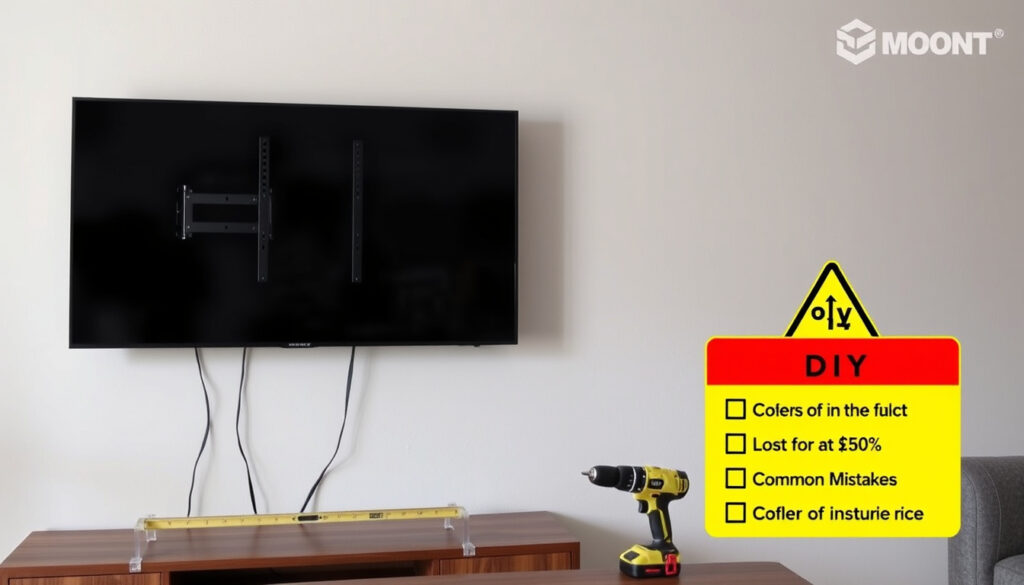
Mounting TV Wall: DIY Costs, Mistakes & Safety Rules (2025)
There’s something about watching a new TV that’s still sitting on its stand — it feels unfinished. You know the picture will look better once it’s up on the wall, but the question is whether you do it yourself or call someone in. This guide walks through the real costs, the common pitfalls, and the step-by-step process so you can decide what’s right for your home in Ireland.
Average professional mounting cost in Ireland: €80–€150 ·
DIY tool cost (basic): €20–€50 ·
Common VESA pattern for 55-inch TVs: 400×400 mm ·
Maximum weight for standard wall mount: 50 kg ·
Average installation time: 30–60 minutes
Quick snapshot
- Requires basic tools (€20–€50 if you don’t own them) (Currys Ireland electronics retailer guide)
- Time: 1–2 hours (Currys Ireland electronics retailer guide)
- Risk of errors if studs are missed (Currys Ireland electronics retailer guide)
- Costs €80–€150 depending on TV size and region (Promount Irish TV mounting service)
- Includes labour, guarantee, and usually cable management (Promount Irish TV mounting service)
- Time: 30–60 minutes (Promount Irish TV mounting service)
- Missing studs – the most frequent error (Currys Ireland electronics retailer guide)
- TV mounted too high (eye level at seated position is 42–48 inches) (Currys Ireland electronics retailer guide)
- Not using a spirit level (Currys Ireland electronics retailer guide)
- Attach mount to wall studs or solid concrete – never drywall alone
- Check TV weight against mount capacity (max 50 kg for standard mounts)
- Hide cables properly – in-wall work may need an electrician
Six key facts that every Irish homeowner should know before starting the job:
| Fact | Value |
|---|---|
| VESA standard | 200×200, 400×400, etc. |
| Stud spacing | 16 inches on centre (40.6 cm) |
| Drill bit size | Depends on anchor type |
| TV height from floor | 42–48 inches (106–122 cm) to centre of screen |
| Mount tilt angle | Up to 15 degrees |
| Cable hiding method | In-wall conduit or plastic cable covers |
Can I install a TV wall mount myself?
Yes, most TV wall mounts can be installed DIY with basic tools. The key is preparation and patience. Currys Ireland electronics retailer guide recommends using a stud finder, a spirit level, and a drill with the correct bit for your wall type.
What tools are needed?
- Stud finder
- Spirit level
- Drill with masonry or wood bits
- Screwdriver (manual or electric)
- Measuring tape
- Pencil for marking
- Rawlplugs (for plasterboard if unavoidable, but not recommended for heavy TVs)
What are the steps to install a TV mount?
- Choose a location – find a stud spacing that matches your mount’s bracket holes. Use a stud finder to mark centres.
- Hold the wall bracket against the wall at the desired height (42–48 inches to centre). Use a spirit level to ensure it’s straight.
- Mark drill holes through the bracket slots, then set the bracket aside.
- Drill pilot holes into the studs. Use a drill bit slightly smaller than your screws. Insert rawlplugs if going into masonry.
- Secure the bracket with lag bolts or heavy-duty screws. Tighten fully but don’t strip the threads.
- Attach the TV brackets to the back of the TV – lay the TV screen-down on a soft surface, align the brackets with the VESA holes, and screw them in.
- Lift the TV onto the wall bracket with the help of another person. Lock it into place (most mounts have a safety latch).
- Double-check level and tighten any final screws.
How to ensure the mount is secure?
After installation, gently tug the TV in all directions. If it shifts, check that all bolts are tight and that the bracket is anchored into studs. Currys Ireland electronics retailer guide advises connecting all cables (power, HDMI, soundbar) before lifting the TV into place to avoid straining the connections.
A DIY install is perfectly feasible for anyone comfortable with a drill. But the line between a secure mount and a disaster is a single missed stud. The implication: if you’re unsure about finding studs, the peace of mind of a professional may be worth the €80–€150.
How much would it cost to wall mount a TV?
Prices vary widely across Ireland, but the pattern is clear: DIY costs €20–€50 in tools (if you don’t already own them), while a professional installation runs from €70 to €259 depending on TV size and service level.
Cost breakdown: DIY vs professional
| Option | Low end | High end | Includes |
|---|---|---|---|
| DIY (tools only) | €20 | €50 | Stud finder, level, drill bits, anchor kit |
| DIY (tools + mount) | €45 | €200 | As above plus TV bracket |
| Professional (small TV ≤44″) | €70 | €109 | Labour, basic mount, cable management |
| Professional (55″ TV) | €85 | €120 | Labour, mount, guarantee |
| Professional (65″–85″) | €105 | €259 | Labour, heavy-duty mount, full service |
Average prices in Ireland
- Taskmaster home services marketplace advertises TV mounting from €70.
- Dublin TV Services local installation provider charges €85 (VAT incl.) for TVs under 65 inches, €105 for 65-inch, and from €150 for larger.
- Promount Irish TV mounting service lists €110 for 50-inch or smaller, €120 for 55-inch, and €130 for 65-inch to 100-inch.
- Installer.ie nationwide service platform starts at €109 (Bronze, 0–44″) and goes up to €259 (Gold, 43–85″).
- Bark Ireland service comparison platform gives a nationwide average of €140, with a Leinster average of €100 and premium of €160.
- Airtasker Ireland peer-to-peer service platform listings show jobs from €50 to €120.
Factors affecting cost
- TV size – larger TVs need heavier brackets and more labour.
- Wall type – brick/concrete is straightforward; plasterboard over studs is fine; lath and plaster is trickier.
- Cable hiding – professional in-wall cable management adds €30–€80.
- Mount type – fixed flat mounts are cheapest; full-motion extendable arms cost more. Taskmatch local service directory reports brackets from €25 for flat mounts to over €150 for extendable.
- Location – Dublin and commuter belt prices tend to be higher.
If you already own a drill and a level, the marginal cost of DIY is just the mount (€20–€50). But if you have to buy tools and a decent mount, the difference between DIY and a basic professional install shrinks to about €30–€50. For a one-off job, the convenience may be worth it.
What are the rules for mounting a TV on the wall?
Safety regulations in Ireland don’t spell out a specific TV-mounting law, but general building standards apply. The key rule: the mount must be attached to a structural part of the wall — studs, solid brick, or concrete block.
Safety rules
- Always attach to studs or solid wall – drywall alone cannot support a TV’s weight. Currys Ireland electronics retailer guide warns that using only plasterboard anchors can lead to the TV falling.
- Use a spirit level – a crooked mount is not just ugly; it can put uneven stress on the bracket.
- Check the weight rating – the mount’s maximum load must exceed the TV’s weight. Standard mounts are rated up to 50 kg.
- Lift with a helper – Currys Ireland electronics retailer guide stresses that lifting a TV alone is risky for both the screen and your back.
Weight and VESA compatibility
VESA (Video Electronics Standards Association) defines the hole pattern on the back of your TV. Common patterns are 200×200 mm for smaller TVs, 400×400 mm for 55-inch models, and 600×400 mm for 65-inch and above. Always match the mount’s VESA pattern to your TV’s – most mounts come with universal brackets that fit multiple patterns.
Wall type considerations
- Drywall over wooden studs – standard. Use a stud finder and drill into the studs.
- Brick or concrete – use a masonry drill bit and rawlplugs. The mount can be placed anywhere.
- Plasterboard without studs – not recommended for TVs over 15 kg. If unavoidable, use heavy-duty toggle anchors rated for the TV weight.
- Lath and plaster – tricky. Studs may be irregular. Consider a professional.
Electrical safety if hiding cables
If you cut into the wall to run HDMI and power cables, you may need to comply with Part P (Building Regulations) in Ireland. In-wall mains cabling should be done by a registered electrician. Dublin TV Services installation provider notes that many of their customers opt for surface-mount cable covers to avoid the cost of an electrician.
The catch: mounting rules are straightforward, but the electrical requirement for in-wall cable hiding often catches DIYers off guard. A registered electrician adds €50–€100 to the job.
What are the common TV mounting mistakes?
Even experienced DIYers make these errors. The most frequent is missing the studs entirely.
Mounting on drywall without studs
This is the #1 mistake. Drywall anchors are not designed to hold the weight of a TV, especially when the mount is pulled away from the wall. Currys Ireland electronics retailer guide says: “Don’t rely on plasterboard alone – it’s simply not strong enough.”
Incorrect height
Many people mount the TV too high (above a fireplace, for example). The ergonomic rule is that the centre of the screen should be at eye level when seated – typically 42–48 inches (106–122 cm) from the floor.
Not using a level
A tilted TV is distracting. Currys Ireland electronics retailer guide advises checking the level both before drilling and after tightening the bracket.
Ignoring VESA pattern
Buying a mount that doesn’t match your TV’s VESA pattern is a waste of money. Always check the manual or measure the hole spacing on the back of your TV.
Leaving cables exposed unsafely
Loose cables can be a tripping hazard, and dangling power cables near the floor are a risk for pets and children. Use cable covers or an in-wall conduit. If you go in-wall, hire an electrician for the mains part.
The most expensive mistake is replacing a TV that fell off the wall. Promount Irish installer says they often get calls to remount TVs that were installed incorrectly by the owner. That second visit costs the same as the first.
How to mount a TV for beginners
If you’ve never done it before, follow this step-by-step. It’s designed for a standard drywall-with-stud scenario.
Tools checklist
- Stud finder
- Spirit level
- Drill with appropriate bits
- Screwdriver (or drill with screwdriver bit)
- Measuring tape
- Pencil
- Socket wrench (if mount uses bolts)
- A helper (crucial for lifting)
Step-by-step guide
- Locate studs – run the stud finder across the wall. Mark the centre of each stud. Standard spacing is 16 inches (40.6 cm) on centre.
- Mark the height – measure 42–48 inches from the floor to where you want the centre of the TV. Hold the wall bracket at that height and check with a level. Mark the drill holes.
- Drill pilot holes – use a drill bit slightly smaller than the screws. Drill into the studs. If you hit a metal stud, use a self-tapping screw.
- Attach the wall bracket – align the bracket with the pilot holes, insert lag bolts, and tighten with a socket wrench. Do not overtighten.
- Attach TV brackets – lay the TV face-down on a soft blanket. Currys Ireland electronics retailer guide recommends using a surface larger than the TV. Align the brackets with the VESA holes and screw them in using the provided screws. Don’t overtighten – use the correct length.
- Connect cables first – plug in power, HDMI, and any other cables while the TV is still on the floor. It’s much easier.
- Lift the TV onto the wall bracket – with your helper, lift the TV and hook the brackets onto the wall plate. Most mounts click into place; you may hear a lock engage.
- Secure and level – tighten any locking screws. Use the level one last time. If the TV is tilted, adjust the tilt mechanism on the mount.
- Manage cables – use cable ties or a cable cover to keep things tidy. If you cut a hole in the wall, call an electrician for the mains cable.
Safety precautions
- Always have a second person to help lift the TV – it’s heavy and awkward.
- Double-check that all screws are tight. Loose screws can cause the TV to slip.
- Test the mount by gently pulling the TV after installation. If it moves, recheck the bolts.
- Keep children and pets away during installation.
Testing stability
Once mounted, the TV should not wobble when you gently push it. If you have a full-motion mount, extend it fully and check that the arm doesn’t sag. Currys Ireland electronics retailer guide recommends periodic checks – especially after a few months, as screws can settle.
The most time-consuming part of a DIY mount is the careful measuring and leveling. Once that’s done, the actual lifting takes 30 seconds. But rush the measuring, and you’ll spend the next year looking at a crooked TV.
Upsides and downsides of DIY vs professional
Upsides
- DIY saves €50–€100 on labour
- You control the exact height and placement
- No need to schedule an appointment
- Learning a useful skill
Downsides
- Risk of damage if studs are missed
- Need to buy or borrow tools
- Heavy lifting without a helper can be dangerous
- No guarantee if the TV falls
What’s clear and what’s still unclear
Confirmed facts
- TV mount must be attached to wall studs or solid concrete.
- Use a level to ensure the TV is straight.
- Check VESA compatibility before buying a mount.
- Professional mounting in Ireland costs between €70 and €259 depending on TV size and service.
- Currys Ireland electronics retailer guide recommends using a spirit level and rawlplugs.
What’s unclear
- Whether you need an electrician depends on if you plan to hide cables inside the wall.
- The exact cost of professional mounting varies by region and TV size – Dublin averages differ from rural areas.
- Long-term safety of plasterboard toggle anchors for TVs over 20 kg is not well documented.
What professionals say
“Don’t rely on plasterboard alone – it’s simply not strong enough. Always use a stud finder and a spirit level before drilling.”
— Currys Ireland electronics retailer guide
“We get calls every week from people whose TV fell off the wall because they tried to mount it on drywall without studs. A professional install costs about the same as replacing a broken screen.”
— Promount Irish TV mounting service
“For a 55-inch TV, the average job takes us 45 minutes. That includes finding studs, mounting, and cable management. A DIY person might take two hours and still have a wonky result.”
So, what’s the right call?
For Irish homeowners, the decision comes down to three things: your comfort with tools, the value of your time, and the risk tolerance for a fallen TV. DIY is absolutely doable if you own a stud finder and a level, and you’re methodical. But if you’re mounting a 65-inch OLED above a fireplace, the €85–€150 for a professional is cheap insurance. The pattern: for the many Irish households that mount a single TV and never touch it again, the trade-off is clear — pay a pro once, or buy the tools and learn a skill you’ll use maybe twice in a decade.
Related reading: Irish Shower Head Guide: Fit, Types & Pressure · Stools Bar in Ireland: Clearance Sales & Retailer Guide
If you’re considering a DIY approach, this TV wall mounting guide details the costs and safety rules you need to know.
Frequently asked questions
What is a VESA pattern?
VESA (Video Electronics Standards Association) defines the pattern of screw holes on the back of a TV. Common patterns are 200×200 mm, 400×400 mm, and 600×400 mm. Your mount must match this pattern. Check your TV’s manual or measure the distance between holes horizontally and vertically.
Can I mount a TV on plasterboard?
Plasterboard (drywall) alone is not strong enough to support a TV’s weight. You must anchor the mount into wooden studs behind the plasterboard or use heavy-duty toggle bolts rated for the TV’s weight. For TVs over 15 kg, stud mounting is the only safe option.
How do I hide cables after mounting?
You can use plastic cable covers that stick to the wall and paint over them, or cut a channel in the wall and run cables through a conduit. If you cut into the wall, the mains power cable should be handled by a registered electrician in Ireland.
What type of mount should I buy: fixed, tilting, or full-motion?
Fixed mounts are cheapest and keep the TV flush against the wall. Tilting mounts allow you to angle the screen down (useful above a fireplace). Full-motion mounts let you pull the TV away and swivel it – best for corner installations or rooms with multiple viewing angles.
Do I need a special bracket for a curved TV?
Most curved TVs use standard VESA patterns, so any compatible mount will work. However, the curvature can make the TV stick out slightly more from the wall. Some mounts offer curved brackets, but they are not essential.
How often should I check the mount’s tightness?
Check the bolts every 6–12 months, especially if you have a full-motion mount that you move frequently. Vibration from sound systems can loosen screws over time.
Is it safe to mount a TV above a fireplace?
Yes, but the heat from the fireplace can damage the TV. Ensure the mantle is deep enough to deflect heat, and consider a tilting mount to angle the screen down for comfortable viewing. The TV should be at least 6 inches above the fireplace opening.
More related posts
 Sticky Toffee Pudding Recipe: Gordon Ramsay vs Nigella vs Berry
 Luther Vandross: Life, Death, and Private Legacy
 Jeremy Renner Accident, Recovery & Allegations
 Stacy Keibler: Net Worth, WWE Career, and Life Now
 Nathan MacKinnon: Salary, Girlfriend, Stats, and Personal Life
 iPhone 11 Release Date: Sep 20, 2019 – 2026 Longevity
 1.4 kg to lbs: Convert 1.4 Kilograms to Pounds (3.086 lb)
 Jujutsu Kaisen Season 3 & 4: Official News and Release Date